You just closed on a house, and somewhere in the paperwork the previous owner mentioned a dog fence in the yard.
Maybe you spotted a mystery box mounted on the garage wall. Maybe there are a few faded training flags tucked behind a workbench. Or maybe you opened a kitchen drawer and found a receiver collar that clearly belonged to a dog that moved out before you moved in.
If you have a dog, or you're planning on getting one, that buried system could be a valuable feature of your new home.
The question is whether it still works.
The good news is that an existing underground dog fence does not necessarily need to be replaced just because it is older, missing parts, or made by a different manufacturer. In many cases, the buried wire can be repaired or reused while the electronics are serviced or upgraded.
Here’s how to figure out what you inherited without digging up the yard.
First, Figure Out What's Actually Buried Out There
Before deciding whether to repair, upgrade, or replace an underground dog fence, start with two basic questions:
- What type of system is installed?
- Does it still power on?
Find the Transmitter
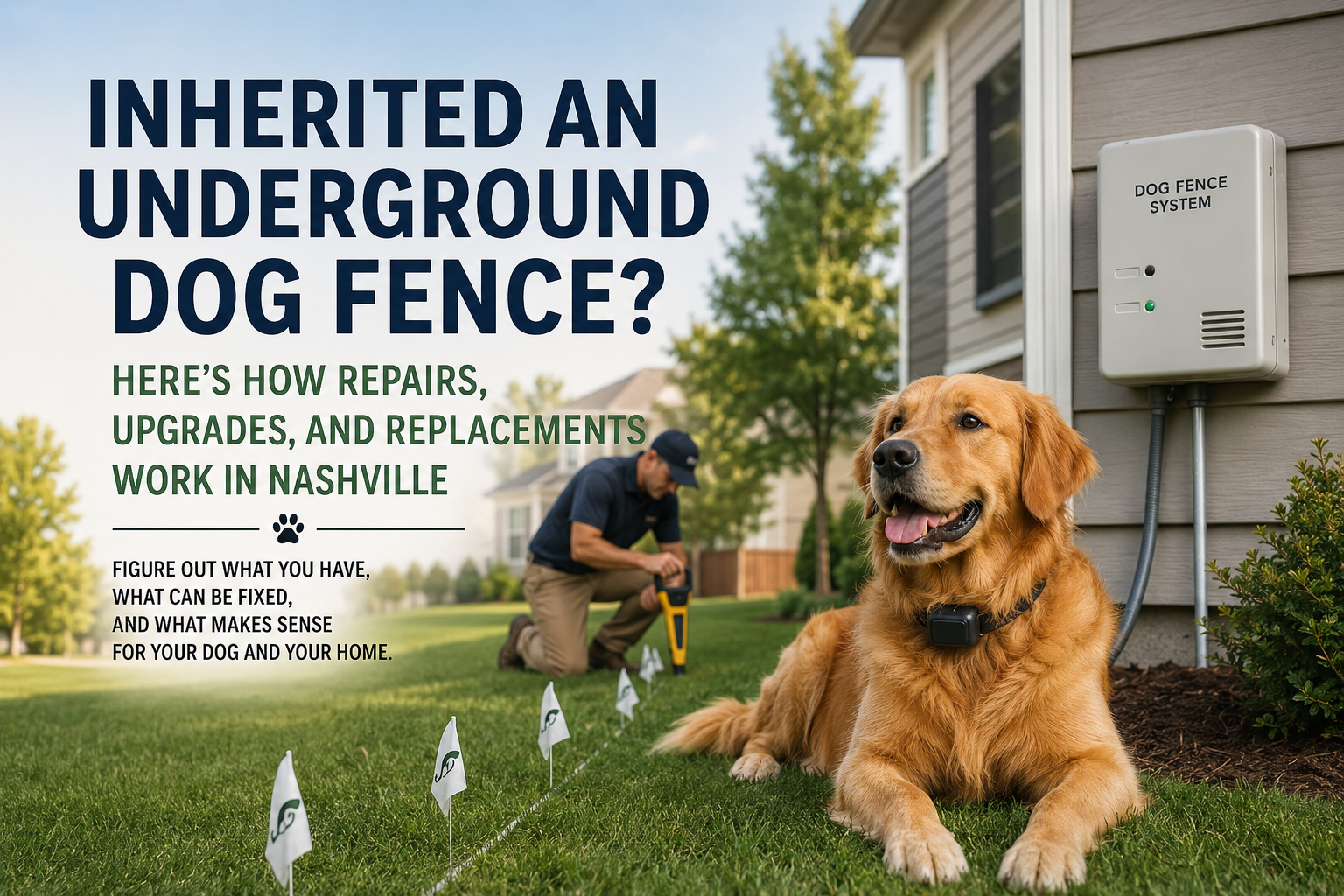
The transmitter is the brain of a traditional underground dog fence. It is usually a small wall-mounted box located in the garage, basement, utility room, or another area near an electrical outlet.
If the transmitter lights up when plugged in, that's a promising start.
If it doesn't, don't immediately assume the entire fence is bad. The electronics and buried boundary wire are separate components. A problem with the transmitter does not automatically mean hundreds or thousands of feet of wire buried around the property need to be replaced.
Identify the Manufacturer and Model
Homeowners often use terms such as "invisible pet fence," "electric dog fence," and "underground dog fence" to describe the entire category.
The actual equipment, however, can vary considerably from one manufacturer to another.
That matters because receiver collars, transmitters, batteries, frequencies, and other components are not necessarily interchangeable.
Garage Wall Detective: Before calling a professional, take a clear photo of the transmitter, including the manufacturer's name, model number, and any indicator lights. If the previous homeowner left a receiver collar, photograph that too. Those pictures can provide useful clues about what you have before a technician even arrives.
Underground Dog Fence Repair in Nashville: What Can Be Fixed?
A system that isn't working today may still have plenty of useful life left in it.
One common problem is a break somewhere in the buried boundary wire. Landscaping projects, utility work, irrigation installations, tree planting, driveway work, and other digging around the property can accidentally damage a wire.
Fortunately, finding a wire break doesn't usually require digging up the entire yard. Specialized equipment can be used to trace the boundary and help locate the problem area. Once identified, the damaged section may only require a relatively small repair.
The transmitter can also be the source of the problem. Electronics age, and power surges and storms can take their toll on equipment over time.
Then there is perhaps the simplest possibility of all.
Nothing is actually broken.
The previous homeowners simply took their dog's receiver collar with them.
When the Collar Is the Only Missing Piece
This is one of the easiest inherited-fence scenarios.
The boundary wire may still be intact. The transmitter may still be functioning. The only thing missing is the equipment your dog actually wears.
Before purchasing a replacement collar, however, make sure it is compatible with the existing system. Underground fence equipment can use different signal technologies, frequencies, receiver designs, and battery systems.
There is another reason not to simply put an old receiver collar on your dog and start using the fence.
That collar may have been configured for an entirely different animal.
The previous homeowner might have owned a large, determined Labrador. You might have a 20-pound rescue dog that responds immediately to an audible warning.
A dog's introduction to an underground fence should be based on that dog's temperament, size, behavior, and training needs, not whatever settings happened to work for the dog that lived there before.
You May Be Able to Upgrade Without Re-Trenching the Yard
This is where an inherited system can become particularly valuable.
The buried boundary wire is one of the most labor-intensive parts of installing a traditional underground dog fence. Depending on its condition and configuration, that wire may continue to be useful even when the original electronics are outdated.
Instead of starting over, a technician may be able to evaluate the existing loop and determine whether it can be used with newer equipment.
That can mean replacing or upgrading the transmitter and receiver collar while leaving a functional underground boundary in place.
For a homeowner, that is worth investigating before assuming a completely new installation is necessary.
DogWatch of Nashville trade-in and upgrade options can provide another option for homeowners who inherit an existing underground fence but want newer equipment.
The important point is that the name on the old transmitter does not necessarily determine what you have to use forever. An existing system should be evaluated based on the condition of the wire, electronics, layout, available replacement components, and what will work best for your dog.
Worth Knowing: If you tell a pet fence professional that your new house has an "invisible dog fence," they may still need to know exactly what equipment is installed. A quick photo of the transmitter and receiver collar can help identify the system and available options.
When Full Replacement Makes More Sense
Not every inherited system is worth saving.
Sometimes starting fresh makes more sense, particularly if the underground wire has multiple damaged areas, old repairs have deteriorated, replacement components are difficult to obtain, or the existing boundary no longer fits the way you plan to use the property.
Imagine that the previous owners installed their boundary 15 years ago.
Since then, perhaps a pool has been added. A garden now occupies part of the backyard. A detached garage was built. You want the dog to have access to an area that was previously excluded.
At that point, the question isn't simply, "Can this fence be repaired?"
A better question is, "Does this fence still make sense for this property and this dog?"
An on-site assessment can help answer that. The existing boundary can be traced, the equipment tested, and the overall layout evaluated before deciding whether repair, upgrade, or replacement offers the best value.
Don't Skip the Training Step
There is one thing the previous homeowners couldn't leave behind.
Their dog's understanding of the boundary.
The buried wire may already know where the property line is. Your dog doesn't.
A dog that has never used an underground fence needs to learn what the warning signals and boundary flags mean. That introduction should happen gradually through training rather than simply putting on a receiver collar and turning the system on.
Training flags provide a visible reference while the dog learns the hidden boundary. Voice commands, leash work, audible warnings, repetition, and positive reinforcement help establish where the dog can and cannot go.
Over time, the flags can be removed as the dog learns the boundary.
The technology matters, but training is what teaches the dog how to live comfortably within it.
Good Fences Make Good Homecomings
Moving into a new house comes with plenty of surprises.
Some are expensive.
An underground dog fence that someone else already paid to install can be one of the good ones.
Even if the system isn't currently working, don't assume it needs to be torn out or completely replaced. The problem might be a damaged section of wire, an aging transmitter, a missing receiver collar, or electronics that can be upgraded while keeping the existing boundary.
Start with what you already have.
Find the transmitter. Identify the equipment. Have the buried loop tested. Then decide whether repair, upgrade, or replacement makes the most sense for your property and your dog.
DogWatch of Nashville can evaluate existing underground dog fence systems throughout Middle Tennessee and help homeowners understand their options. You can request an in-yard estimate or
call to schedule a visit.
FAQs
What is the best way to handle an underground dog fence when I don't know its history?
Start by identifying the transmitter and having the system professionally tested before buying replacement parts. A technician can evaluate the transmitter, check the buried loop for breaks, identify the existing equipment, and determine whether the system can be repaired or upgraded.
This can save you from buying a receiver collar or other component that isn't compatible with what is already installed.
Can I find out where the buried dog fence wire runs if the previous owner didn't leave a map?
Yes. Specialized locating equipment can be used to trace an underground boundary wire and mark its approximate route around the property.
Knowing where the wire runs is useful even when the fence is working properly. It can help prevent accidental damage when installing irrigation, planting trees, building a patio, landscaping, or completing other projects that involve digging in the yard.